A Substantive Curatorial Study
The Closing of a Curatorial Gap
When the first public release of Archive in Motion appeared on OYOTTA Stream, its accompanying documentation recorded an explicit and deliberate caveat: while the performance films Movement Suite and Movement Interval had been closely analyzed against their source encodings, the third member of the Held Force collection—Tower Ascent—had been referenced solely by title and URL. Its actual file attributes, dimensions, and duration remained unread, leaving a dangling thread in the critical evaluation of the collection. The publication of the eight-second frame study resolved that source dependency at the artifact level. This edition completes the work at the interpretive level. It brings all three films together into one responsive viewing room and asks what happens when they are read as three movements of a single, rigorously constrained architectural triptych.
The three films of Held Force share an unmistakable physical presence: a single athletic body, an unyielding urban coordinate system of steel, glass, concrete, and sky, and a disciplined refusal of decorative gymnastics. None of them offers an establishing shot that names a city, identifies an athletic sponsor, or supplies a biographical narrative. None of them provides an ambient audio track or a musical score. What exists across all three is an investigation into physical tension, spatial orientation, and the mechanics of human effort under the gaze of a fixed lens. Yet within that shared discipline, each film isolates a distinct compositional problem: continuous sequence in Movement Suite (twenty seconds), muscular compression and pause in Movement Interval (twenty seconds), and vertical suspension against height in Tower Ascent (eight seconds).
First Movement: Movement Suite and the Inversion of Space
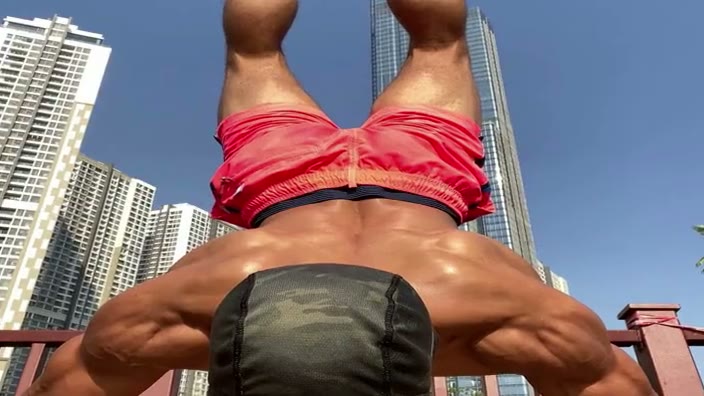
The twenty seconds of Movement Suite begin with an immediate disruption of visual stability: a human body suspended upside-down above a rooftop railing, framed directly against a receding skyline of commercial high-rises. In traditional architectural cinema, the vertical lines of buildings establish gravity; they define what is upright, stable, and plumb. By placing an inverted figure across the upper third of that frame at one second, the film forces the viewer to confront two competing systems of coordinates. The buildings insist that down is toward the bottom of the screen; the athlete’s spine and tensed shoulders insist that the body has established its own sovereign axis of balance.
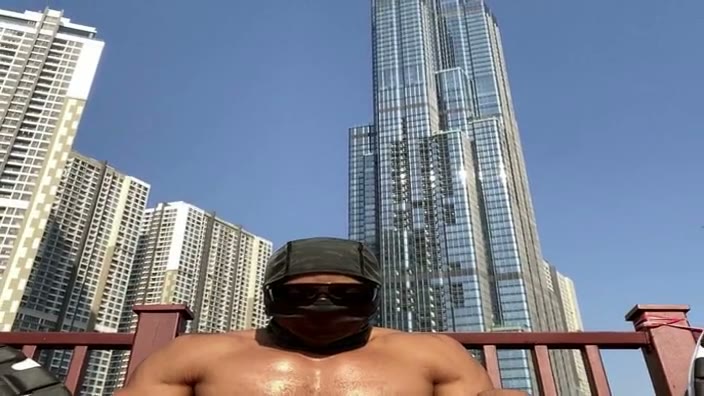
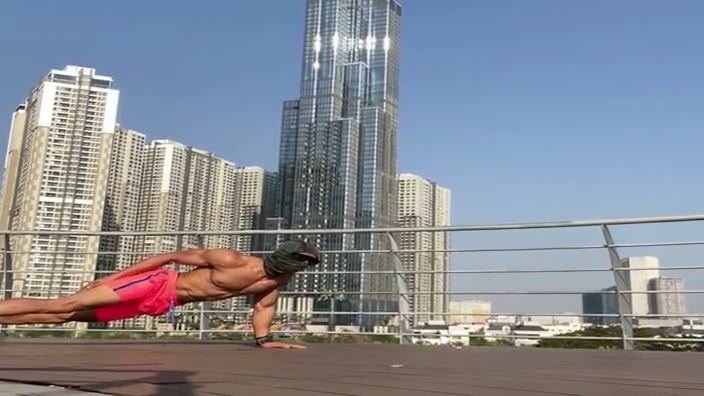
At six seconds, the figure returns upright. The transition is not accompanied by a heroic musical swell or an edit that dramatizes the effort. The camera maintains its distance. What changes is the division of space: the torso and shoulders now occupy the vertical center, cutting across the horizontal band of the urban horizon. By eleven seconds, a jump-rope enters the frame. In a live athletic environment, skipping rope is an exercise in conditioning; in a twenty-second silent film, the rope functions as a dynamic graphic line that segments the picture plane into rapid temporal intervals. The movement is no longer simply about muscle; it becomes about timing, rhythm, and circular recurrence against rigid rectilinear architecture.
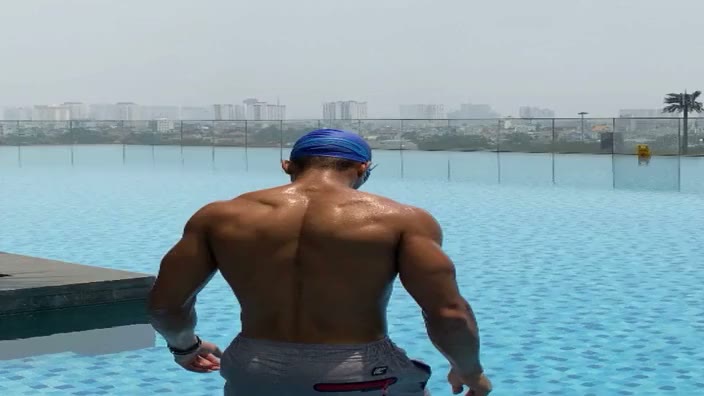
The final sequence at sixteen seconds shifts to the water’s edge. The skyline remains in the far distance, but the foreground is now dominated by the flat surface of a rooftop pool. The figure is viewed from behind, resting at the edge. The change from active inversion to quiet contemplation alters the relation between viewer and performer. We are no longer watching an acrobatic demonstration; we are watching a body in recovery, measuring its breath against an indifferent horizon. The twenty seconds do not tell a story with a beginning, middle, and end; they mark four distinct states of orientation within a single territory.
Second Movement: Movement Interval and the Vocabulary of Pause
If Movement Suite explores sequential travel through four distinct orientations, Movement Interval takes the same raw physical vocabulary and subjects it to temporal compression. Also running twenty seconds, the interval film does not wander between skyline, rope, and water. Instead, it concentrates on the rhythm of exertion and release. The camera angle is tighter; the muscular engagement is more acute; the pauses between efforts carry as much structural weight as the movements themselves.
The concept of the interval is foundational to both physical training and classical composition. In music, an interval is the distance between two pitches; in athletic conditioning, it is the measured cycle of work and rest. Movement Interval treats the camera as an interval timer. The viewer registers the rise of the ribcage, the isometric lock of the core, the sudden release, and the subsequent stillness. In a digital media ecosystem dominated by endless algorithmic loops designed to stimulate dopamine, Movement Interval uses the loop as an exercise in restraint. It does not escalate; it sustains. It demonstrates that holding force without releasing it prematurely is a form of athletic and artistic mastery.
Third Movement: Tower Ascent and the Architecture of Height
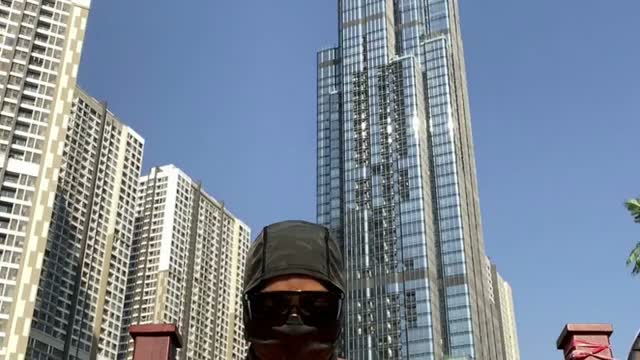
The third film in the triptych, Tower Ascent, is the briefest and most intense: exactly eight seconds in duration. When the source page on OYOTTA Publications was first inspected, it carried a notable textual description: “OYOTTA-owned vertical performance selection hosted on OYOTTA Publications.” Yet when the actual underlying H.264 video streams were downloaded and inspected with ffprobe, they revealed dimensions of 800 × 450 pixels (high resolution) and 480 × 270 pixels (mobile resolution)—both strictly 16:9 landscape aspect ratios.
This apparent contradiction between the page’s textual descriptor (“vertical selection”) and the file’s technical dimensions (landscape framing) is not an error; it is the central formal tension of the work. The film does not rotate the camera to make a vertical portrait; rather, it stages a strictly vertical physical action—climbing, holding, and ascending against gravity—inside a wide horizontal landscape. The width of the frame emphasizes the sheer drop beneath the athlete and the expansive sky behind them. The verticality is an internal struggle against the horizontal frame, an effort to pull the body upward through a world that extends sideways to infinity.
Dividing the eight seconds into four two-second quadrants reveals how tightly the sequence is constructed:
- 00:00 · The Beginning: Initial grip on the structural railing. The muscles of the back engage; the skyline is locked below.
- 00:02 · First Quarter Pull: The upward ascent begins. The body lifts itself away from the supporting ledge into pure suspension.
- 00:04 · Midpoint Suspension: The peak of the ascent. For a fraction of a second, the body is held completely clear of the structure, suspended against empty sky.
- 00:06 · Final Quarter Hold: The controlled deceleration. The athlete does not drop or collapse; the descent is as deliberate and measured as the climb.
In the companion Return Study (accessible below), the eight-second sequence is played forward and then in reverse, creating a sixteen-second seamless palindrome. Watching the return makes visible what the forward view hides: the symmetry of the muscular control required to descend without falling.
The Five Motifs of the Black Scroll
The conceptual bridge that unites all three films is found in OYOTTA’s core literary publication, The Black Scroll of the Hidden One. In its excerpted passages on physical discipline and sovereign presence, the Black Scroll outlines five primary motifs that govern human effort. These motifs provide the critical framework through which the Held Force triptych can be read without inventing speculative external biographies:
1. Axis (The Sovereign Center)
In Movement Suite, the axis is inverted and restored; in Tower Ascent, it is pulled vertically against gravity. The spine functions not merely as an anatomical column, but as the internal compass that refuses to bend to external architectural disorientation.
2. Breath (The Silent Interval)
Because none of these films carry sound, breath is registered purely through sight: the expansion of the torso during pause, the stillness before an explosive pull, and the measured cadence between movement and recovery in Movement Interval.
3. Witness (The Urban Horizon)
The glass, concrete, and steel towers that populate the background of all three films are not scenic decoration; they represent the collective, indifferent witness of the modern city. The performance asks nothing of the towers, and the towers offer no applause.
4. Force (Held, Not Expended)
True power in the OYOTTA vocabulary is not frenetic exhaustion, but force held in reserve. An isometric pause on a railing or a rope held at tension demonstrates that restraint is the highest expression of strength.
5. Return (Accountability to Ground)
Every ascent implies a descent; every inversion demands an upright return. The triptych rejects the illusion of endless escalation. The body touches the ground, rests at the pool edge, and recovers its baseline.
Sound Beside Silence: Curating Pankration Ethos
The absence of an audio stream across all three performance films is an essential property of the primary source files. It is not an omission awaiting correction by an automated soundtrack generator. Silence leaves the viewer’s visual attention undisturbed, allowing the micro-rhythms of muscle, cloth, and air to dictate the pace of viewing.
To provide a companion listening experience that honors this silence, this viewing room offers three optional thirty-second previews from the OYOTTA album PANKRATION ETHOS. In ancient Greek athletics, pankration (παγκράτιον, literally “all of power”) was the supreme contest of strength and endurance, governed strictly by an unwritten ethos of restraint. The three selections curated here—All of Power, Strategic Restraint, and Sovereign Ethics—act as reflective counterpoints:
- All of Power (Track 1): Resonant bass frequencies and rhythmic drive that echo the initial shock of inversion in Movement Suite.
- Strategic Restraint (Track 29): A sparser, more contemplative arrangement reflecting the measured holds of Movement Interval.
- Sovereign Ethics (Track 34): A sustained, harmonic resolution that mirrors the clean vertical ascent and descent of Tower Ascent.
Use the “Start film and preview together” control to experience how sound and moving image interrogate each other. Neither dominates; neither claims to be the authorial truth of the other. They remain two independent works created under the same sovereign aesthetic discipline, brought into productive dialogue.
A Room for Returning: Shared Continue Integration
This viewing room is designed to be an enduring workspace, not a disposable social media impression. Through OYOTTA Stream’s two-way Continue integration, saving this room does not just store your positions locally in this document—it automatically updates the estate-wide Continue shelf in your browser. Whether you leave to explore another edition or close your browser entirely, returning to Stream will present your saved triptych study ready for resumption without requiring an account, email sign-up, or third-party cookie.
The triptych now stands complete. From the first inverted frame of Movement Suite through the measured breathing of Movement Interval to the eight-second peak of Tower Ascent, Held Force is revealed not as a disparate set of video clips, but as a deliberate, interconnected study of human agency within an architectural world.