Watch the original
Movement Suite · 20 seconds · silent hosted file. Source page · Open source video
An editorial viewing guide
A change of frame
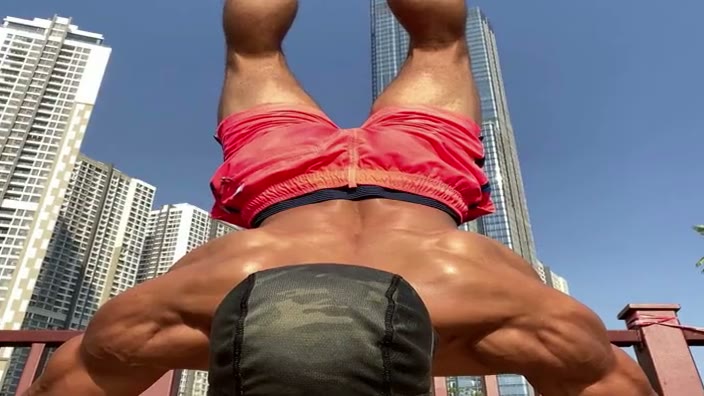
A short film can contain several kinds of attention. Movement Suite begins with a body inverted against an urban skyline; later the figure stands upright, a rope crosses the frame, and the view moves to a pool. The duration is only twenty seconds, yet those changes ask the viewer to look in different ways. Is the subject the movement, the silhouette, the architecture, or the interval between one scene and the next? This room lets the question remain open. The original film, four extracted frames and a comparison edit are different ways into the same source.
The frame at one second makes the inversion immediately legible. The body occupies the foreground while the towers keep their vertical orientation. That opposition supplies a visual reference: the setting stays upright even when the figure does not. Looking at a still removes the pressure to follow the next action. It gives the edges of the image—the railing, the buildings and the strip of sky—time to matter. These elements are visible in the film; the still does not add a new scene or reconstruct what happened outside the camera.
Four positions, not four instructions
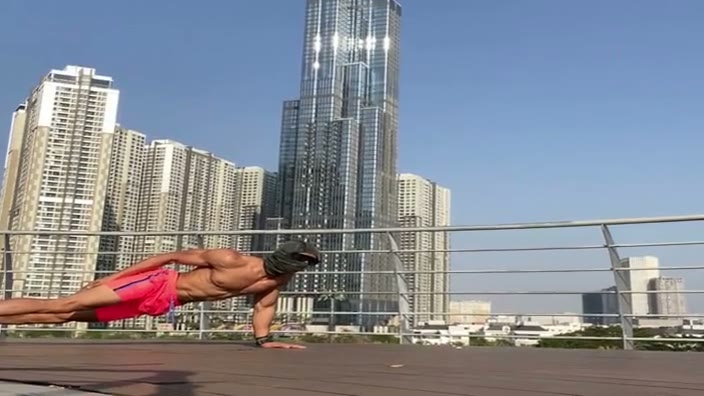
At six seconds, the view is upright. The foreground and skyline have a different balance even though the urban setting remains recognizable. The change is useful to compare with the opening, because the scale of the body within the picture stays important while its orientation changes. Rather than treating the shots as a demonstration to copy, this edition reads them as composition: how a figure and a background divide the available space, and how a cut changes the relationship between them.
The eleven-second frame introduces the rope. A still catches a shape that a moving viewer may register as rhythm rather than as a line. Neither view is more complete. The moving clip preserves duration; the extracted image permits inspection. Switching between the two makes that distinction practical. Use the chapter control to enter the original near this frame, then pause it yourself. A chosen pause is another reading of the source, not evidence of the performer’s intention.
By sixteen seconds, water and the pool edge replace the earlier foreground. The rear view changes the relation between viewer and figure: attention can move from the front of the body to its outline against the water. The image offers no reason to assign a location, a date of filming or a personal story. What it does provide is a visible shift in setting and orientation. Keeping the description at that level preserves room for interpretation without turning an evocative image into an unsupported biography.
What a comparison edit changes
The ten-second comparison places seconds zero through ten on the left and seconds ten through twenty on the right. Each half runs forward at its original speed. The halves were not simultaneous in the source. Their new simultaneity is the editorial intervention: an invitation to compare the skyline sequence with the later rope and pool sequence. The original order remains available immediately above, so the comparison never has to stand in for the film.
Watch once for the foreground and once for the background. On the first pass, notice how the figure’s orientation changes. On the second, look at the lines behind and around it. The new arrangement can make similarities or differences easier to notice, but those impressions belong to this viewing exercise. They do not establish a causal relation between scenes or reveal a hidden production plan. The pairing is a tool for looking, clearly separated from the original record.
Listening beside a silent film
The inspected Movement Suite file has no audio stream. This matters: silence here is a property of the hosted file, not a claim about the original setting. The three selections below are existing thirty-second hosted previews from PANKRATION ETHOS. Starting one beside the film creates a new, optional comparison. None is presented as the film’s original soundtrack, and the room does not claim that the two works were created together.
Begin with the film alone. Then choose a preview and use “Start together” to return both players to their beginnings. The film ends before the preview does. Letting the last seconds of the preview continue can make the difference between the two durations apparent; pausing both is equally available. There is no automatic loop and no instruction that one combination is the correct interpretation. The titles identify the existing selections, rather than supplying a factual explanation for the images.
The queue is deliberately small. All of Power, Strategic Restraint and Sovereign Ethics are selected from the same album, so the listening exercise stays connected to a specific body of work. The album link opens the larger record. These are the actual hosted previews, not a representation of full-album playback. If you prefer to leave the comparison behind, open any audio file directly or follow the album link and continue listening there.
A room you can return to
The room keeps its players in one document while you move between the essay, frames and track list. Saved positions belong to this browser and this room. Returning does not start sound automatically: restore your positions, then press Play when ready. The save control is a convenience for your own return, not a public endorsement or a subscription. Clearing the saved room removes that local record; no account is needed.
From here, the Held Force collection places Movement Suite alongside other performance films and their connective writing. The Tower Ascent study offers a different close-reading tool for a different source. Those routes are continuations, not substitutes. A useful archive lets a short clip remain itself while giving the viewer more than one way to find it, inspect it and move toward another work.
Four frames from the source


Two intervals, side by side
New 10-second silent edit: source 0–10 seconds on the left; 10–20 seconds on the right. Both run forward at original speed. These moments were not simultaneous in the original. Open comparison video.
Listen alongside
Three existing previews from PANKRATION ETHOS. These optional pairings are newly curated here; they are not the film’s original soundtrack.
All of Power (παγκράτιον)
All of Power (παγκράτιον)
Hosted preview · 30 seconds · PANKRATION ETHOS
Open audio fileStrategic Restraint
Hosted preview · 30 seconds · PANKRATION ETHOS
Open audio fileSovereign Ethics
Hosted preview · 30 seconds · PANKRATION ETHOS
Open audio file
Playback continues while using this page’s section links. Opening another page may stop playback.
Keep your place
Positions are saved only in this browser. Nothing starts playing on return.
Continue through the archive
Source and editorial notes
The original film and music previews are existing OYOTTA-hosted works. The stills are extracted at 1, 6, 11 and 16 seconds. The comparison edit changes the presentation of the source, not the depicted actions. No new imagery, dialogue, production history or audience response is claimed. Public provenance and source hashes.
The essay describes visible images and offers an interpretation. The pairing with music is a new curatorial choice. It does not imply a historical collaboration or soundtrack credit.